

What is symmetric encryption?
Symmetric encryption is one of the most fundamental concepts of cryptography. It is applied in the field of data protection to preserve messages, files, passwords, backups, network traffic (for example, via a virtual private network), and various kinds of digital information. If you use a crypto wallet, a password manager, or a banking application, symmetric encryption may be involved in those processes. If you want to make the management of your digital assets easy and reliable, consider downloading AliceBob Wallet, a multifunctional self-custody wallet with advanced security features.
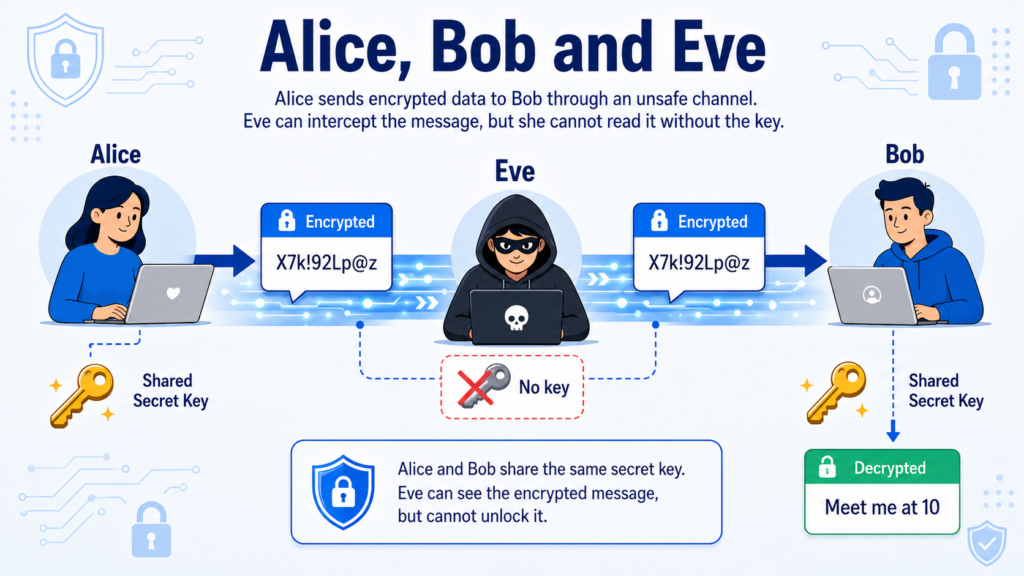
In cryptography, Alice and Bob serve as names of sample characters. Here, Alice wants to send her Bob a private message. She does not want Eve, the hacker, to learn its content. Thanks to symmetric encryption, Alice and Bob can secure the message using the same private key.
While the concept behind symmetric encryption seems straightforward, there is one crucial question to be answered – how can Alice and Bob safely exchange the key?
Symmetric Encryption: Introduction
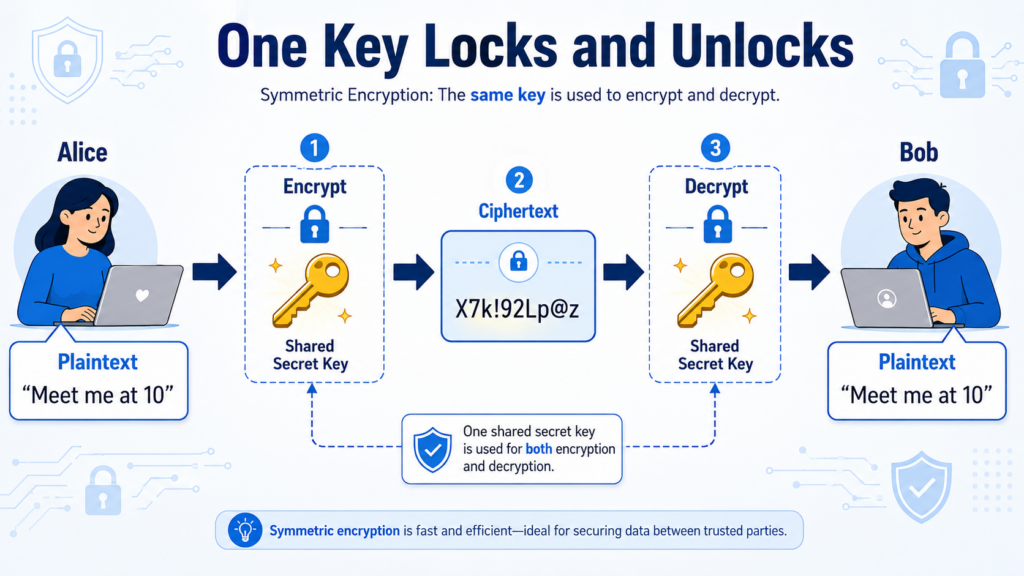
Symmetric encryption or symmetric-key cryptography refers to the type of encryption, wherein the same key is used for both encryption and decryption.
In other words, the encryption process involves turning readable data or plaintext into encrypted data or ciphertext. The inverse process restores ciphertext into the initial readable format. In symmetric encryption, the same key is applied for both purposes.
For instance, Alice sends Bob a message saying, “Meet me at 10.” She uses symmetric encryption with a secret key. The resulting message will look like random gibberish. Only Bob will be able to restore the initial message, if he knows the same secret key.
Symmetric encryption is considered fast and convenient since it allows processing large quantities of data.
Definition of Symmetric Encryption
By definition, symmetric encryption is a data protection technique that relies on a secret key used by the sender and receiver.
The name of this kind of encryption comes from the principle behind the process – it must be symmetrical on both ends, meaning that the same secret key will lock and unlock the data.
Symmetric encryption is different from asymmetric encryption, wherein one public key and one private key are employed for data protection.
The former is considered faster; the latter can be used to resolve the issue of a safe key exchange.
Both approaches are commonly used together in practical systems.
How Does Symmetric Encryption Work?
For a better understanding of how symmetric encryption works, let us take a look at an example with Alice and Bob.
The participants of the interaction need to agree on the secret key in the first place. The key must be kept confidential, or else Eve will be able to get it and easily decrypt any protected information.
Next, Alice prepares the message to be sent. At this point, the message is a plain readable message, or plaintext.
Then, the encryption algorithm and the key are used to turn the message into encrypted data, or ciphertext.
After this step, Alice can safely transfer the ciphertext to Bob via an unsafe channel of communication, since no outsider, Eve included, will be able to decipher the message without the key.
Finally, the same key is used by Bob to return the ciphertext into the plaintext.
Therefore, the quality of symmetric encryption depends on the encryption algorithm, the size of the key, the mode of operation, and proper encryption key management.
The Secret Key in Symmetric Encryption: Management
The encryption key plays a vital role in the process of symmetric encryption.
Even if the encryption algorithm itself is strong, encryption will be useless, if the secret key is weak, compromised, poorly managed, or even reused in multiple sessions.
Key management includes several important tasks:
– Generating a unique random key
– Securely storing the key
– Replacing it, if necessary
– Restricting the list of authorized people to access the key
– Deleting outdated keys
– Not using hardcoded keys in applications and scripts
In case of Alice and Bob, a secret key can be thought of as the combination to a safe. As long as the owners keep it safe, nobody else will be able to crack the code. However, if they use unsafe channels to exchange keys, this opens a door for Eve.
For this reason, modern applications typically do not use only symmetric encryption for this purpose.
Types of Symmetric Encryption
There are two main types of symmetric encryption: block ciphers and stream ciphers.
In block encryption, data is divided into blocks of equal size. If a block is shorter or longer than the message, the encryption algorithm works according the selected mode of operation. AES (Advanced Encryption Standard) is the most popular block cipher.
Stream encryption assumes that the data flows continuously. In most cases, a key stream is generated during encryption, and then combined with plaintext. Stream encryption may be useful, if the information is transferred in real-time.
As for the areas of application, block ciphers are frequently applied for file encryption, hard drive encryption, databases, and encryption protocols. Stream encryption finds its practical application, when efficiency is important.
Common Symmetric Encryption Algorithms
One of the most common symmetric encryption algorithms is AES.
AES is the Advanced Encryption Standard, a block cipher that provides encryption with a 128-, 192-, or 256-bit-long key.
AES is widely used for secure communications, file encryption, storage encryption, virtual private network (VPN) protection, and other applications.
According to NIST, AES is a symmetric block cipher that can protect electronic data.
The second widely used symmetric encryption algorithm is Twofish.
Twofish is another symmetric encryption algorithm that was also one of the finalists for AES selection.
Twofish has very strong key sizes and is flexible enough.
However, nowadays it is often replaced by AES due to better compatibility with compliance requirements.
Another symmetric encryption algorithm is Blowfish.
Blowfish is a symmetric block cipher developed by Bruce Schneier. Previously, it was widely used thanks to its high speed and free license.
Nowadays, Blowfish is not considered the most secure option for file encryption due to older encryption algorithm and outdated key size.
It may be replaced by AES and Twofish in many practical applications.
Symmetric vs Asymmetric Encryption
Both symmetric encryption and asymmetric encryption address different problems and offer distinct solutions.
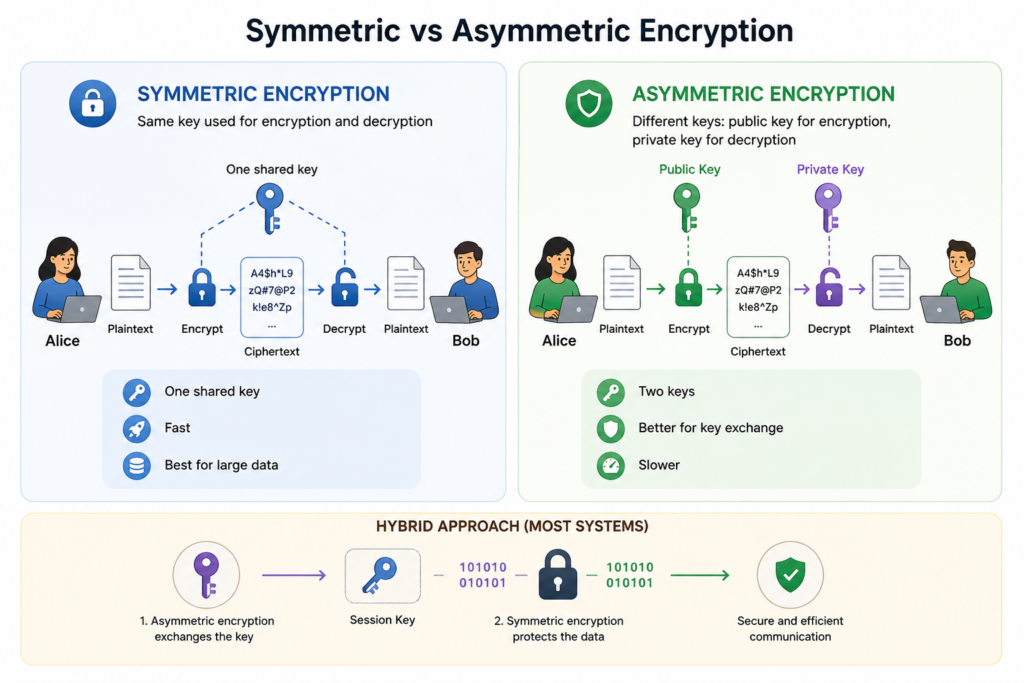
In symmetric encryption, there is only one key used. The approach is quite fast and efficient, which makes symmetric encryption perfect for securing large data volumes.
In contrast, in asymmetric encryption, two keys are used – the public key and the private key. The public key may be made publicly accessible, while the private key must be kept secret. The process of asymmetric encryption can be used for digital signatures and key exchanges.
Since the main issue of symmetric encryption is key management, the approach does not work without a separate solution. This problem can be solved by asymmetric encryption, which allows for a safe key exchange between Alice and Bob.
On the other hand, the disadvantage of asymmetric encryption is its slow speed, which makes it less suitable for handling large amounts of information.
Hybrid Approach in Symmetric & Asymmetric Encryption
The majority of modern secure systems employ a hybrid approach.
Thus, in hybrid encryption, the process starts with using an asymmetric encryption algorithm. Its aim is exchanging a symmetric key. Once this key is established, symmetric encryption can be used to protect any data transmitted between Alice and Bob.
In other words, this approach gives the best of both worlds. Alice and Bob can establish a trustworthy connection using their asymmetric public and private keys. Then symmetric encryption is used for the sake of fast data transfer and efficient encryption.
The described model of data transmission is widely used in secure communications and other systems. Moreover, AliceBob Wallet, as well as other Web3 applications, can greatly benefit from the hybrid encryption strategy.
Main Areas of Application for Symmetric Encryption
Symmetric encryption can be found in practically any secure application or data protection protocol.
Among others, this encryption technique protects files, folders, databases, messages, backups, disk storage, and internal system communication.
Furthermore, symmetric encryption is utilized in payment systems, enterprise networks, government systems, and consumer applications.
In the field of cryptocurrencies, encryption is useful for crypto wallet security, if the system employs self-custody. For AliceBob Wallet, it is particularly useful, as self-custody implies secure management of private data.
Why Do People Use Symmetric Encryption in VPNS?
VPNS use symmetric encryption because it is efficient enough for data flow protection.
When you are using a VPN, you send and receive internet traffic constantly. If the encryption algorithm is not efficient, it would make browsing, streaming, video calls, and downloading problematic.
With symmetric encryption, one may efficiently process continuous data streams. Therefore, symmetric encryption is a perfect choice for securing the traffic of the VPN tunnel.
First, a secure key is negotiated between Alice and Bob using asymmetric encryption. Afterward, symmetric encryption is used for the protection of traffic being transmitted from your device to the remote server.
File Encryption, Folder Encryption, Full-Disk Encryption
Symmetric encryption can also be applied for various kinds of file, folder, and full-disk encryption.
The first one (file encryption) is used for the protection of individual files, the second one (folder encryption) is employed for securing folders containing several files, and the third one (full-disk encryption) serves the purpose of encrypting whole storage drives, including system files and data.
These techniques are useful for people losing or stealing their laptops, phones, and other devices with sensitive data. No person having neither the right secret key nor password will be able to read the encrypted data.
For users who need to securely store wallet backups, seed phrase backups, business files, personal documents, etc., encryption is important. However, encryption does not substitute a safe backup procedure. Otherwise, loss of the key or password may render the backup useless.
Benefits of Symmetric Key Encryption
Some advantages of symmetric key encryption can be named.
Symmetric key encryption is fast and suitable for processing large data volumes.
It is efficient enough to run on most devices.
Symmetric encryption is widely supported, meaning that you will not face difficulties integrating the encryption algorithm into applications, OSs, databases, or other technologies.
Also, it is highly reliable provided proper implementation.
In other words, algorithms such as AES have been extensively tested and are employed by virtually all systems worldwide.
The main limitation related to symmetric key encryption concerns the implementation rather than algorithms themselves. Thus, users must be aware of possible threats such as insecure key management.
Best Practices for Symmetric Encryption
Efficient symmetric encryption involves a few things.
It is important to use well-tested encryption libraries to prevent yourself from inventing a potentially insecure encryption algorithm. Modern algorithms such as AES can be selected whenever possible.
Also, one should generate unique random keys for each session. Predictable passwords are always discouraged.
Keys must be kept separately from encrypted data. Regular key rotation may be necessary depending on the risk circumstances. Access to keys should be restricted only to authorized persons.
Users may benefit from multi-factor authentication. Personal users should pay attention to the password strength, update software regularly, refrain from recovering their phrases and passwords and save backups in secure locations.
Post-Quantum Age for Symmetric Encryption
Two important trends will shape the post-quantum era for symmetric encryption: AI and quantum computers.
In particular, the use of AI in cybernetics may enable threat detection and prevention and help analyze risks in real time. However, it can also give cyber criminals certain advantages, which makes encryption an even more crucial component of a safe online environment.
Quantum computers may become a serious issue for some public-key algorithms sooner or later. While symmetric algorithms will require only increasing key sizes, a new technology will need to be created.
Fortunately, post-quantum cryptography research focuses on asymmetric algorithms currently used for key generation and signing purposes. According to NIST, the first standards for post-quantum key establishment and signatures were released in 2024.
Asymmetric encryption will have to evolve; meanwhile, symmetric encryption is not going anywhere.
FAQ
What is symmetric encryption in simple terms?
Symmetric encryption is an encryption technique employing one secret key used for encrypting and decrypting the information.
Is AES symmetric encryption?
Yes. AES is the Advanced Encryption Standard used in symmetric encryption.
Why is symmetric encryption fast?
Because it uses fewer computations compared to many asymmetric techniques.
What is the main issue with symmetric encryption?
The main drawback of symmetric encryption relates to key management.
Is symmetric encryption applied in crypto wallets?
Yes. It may be used for the protection of local information.
What is the difference between symmetric encryption and asymmetric encryption?
In symmetric encryption, one key is used, whereas in asymmetric encryption, two different keys (public and private keys) are used.
Why is a combination of symmetric and asymmetric encryption used in many systems?
Because asymmetric encryption is used for secure key exchange, while symmetric encryption secures the actual data.
Is symmetric encryption quantum-resistant?
Yes. Symmetric encryption is relatively safe in the age of quantum computing.